Cebu Governor Pamela Baricuatro assured residents that the province is better prepared to face Tropical Storm Basyang after learning from the impacts of past typhoons.
She, however, reminded the public not to be complacent and to strictly follow official instructions.
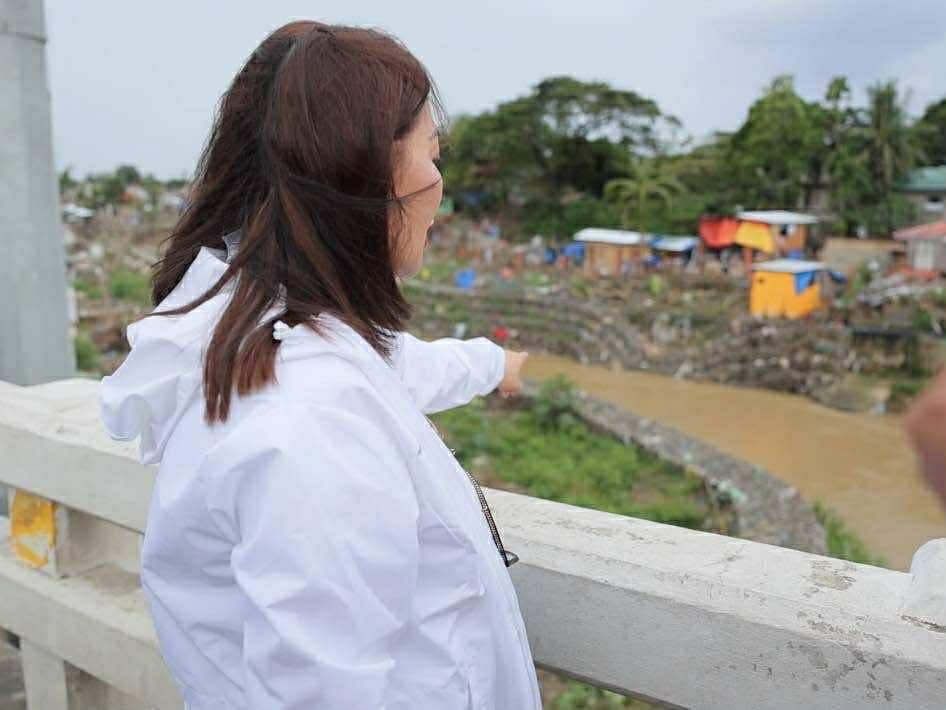
“Akong giawhag ang katawhan nga maminaw ug mo-follow ug morespetar ta sa instructions sa atong mga mayors ug sa atong local disaster risk and reduction management office kay nag-monitor na sila sa bagyo kuyog namo,” Gov. Baricuatro said during an interview at the Mananga River Bridge in Talisay City on Friday morning, February 6.
The governor personally inspected the Mananga River, which had overflowed during Typhoon Tino last year, washing out riverside communities and displacing families.
Authorities have since enforced strict no-build regulations along the riverbanks to prevent future tragedies.
The inspection highlights the provincial government’s proactive approach as southern Cebu prepares for Basyang’s potential landfall.
Baricuatro said the province is now better equipped to reduce the storm’s impact on residents.
She reported that the Provincial Warehouse has stocked 3,500 family food packs, 1,030 sleeping kits, 1,052 kitchen kits, and 1,657 hygiene kits.
The warehouse also holds 2,150 packs of 350ml bottled water and 146 packs of 500ml bottled water, all ready for immediate distribution to affected communities.
In addition, mobile kitchens have been deployed to southern towns, including Moalboal, to provide hot meals for evacuees who may not be able to cook at evacuation centers.
“Ready na for deployment ang packed meals, naa sa Moalboal, kay di pa man kaluto ang naa sa evacuation centers. So we want to make sure nga naay makaon, water and food nga available,” she said.
The governor also coordinated with the Department of Public Works and Highways to pre-position heavy equipment in strategic locations across southern Cebu.
This measure ensures that clearing operations can begin immediately after the storm passes, minimizing disruptions and accelerating relief efforts.
Baricuatro had traveled to Fujian, China, to lead an official delegation focused on strengthening commerce, tourism, and medical partnerships, as well as to study a waste-to-energy facility.
The trip was originally scheduled to end on Saturday, but she returned early on Thursday to oversee Cebu’s preparations.
“Dili gyod ko mahimutang didto, doing a diplomatic job knowing nga kita diri nay moabot nga Basyang,” she said. Despite the shortened visit, she was able to meet with Fujian’s governor to discuss expanded cultural and medical exchanges and the possible resumption of direct Cebu–Xiamen flights.
Meanwhile, the Philippine Atmospheric, Geophysical and Astronomical Services Administration (PAGASA) raised Tropical Cyclone Wind Signal No. 2 over several southern Cebu towns, including Samboan, Malabuyoc, Oslob, Ginatilan, Alegria, Dalaguete, Boljoon, Alcoy, Santander, Argao, and Badian. These areas are considered highly vulnerable to strong winds and heavy rainfall.
In response, the Cebu Provincial Disaster Risk Reduction and Management Office (PDRRMO) placed the province under Blue Alert Status and activated its Emergency Operations Center to ensure continuous weather monitoring and coordination.
Acting Governor Glenn Anthony Soco signed an executive order suspending in-person classes in all public and private schools until further notice.
Education officials were advised to shift to modular learning or other alternative methods where feasible, in line with national disaster response policies.
The move reinforced earlier decisions by local government units that had already halted face-to-face classes in anticipation of severe weather.
Beyond schools, the Capitol has ramped up relief preparations.
Provincial teams from the General Services Office, Social Welfare and Development Office, and Cebu People’s Action Center continue to repack essential goods, ensuring that family food packs, sleeping kits, kitchen kits, hygiene kits, and bottled water are ready for distribution once needed.
Healthcare facilities have also been placed on high alert, with hospitals under Code White Status to ensure medical personnel and resources are fully prepared for storm-related emergencies. (with SBA)