



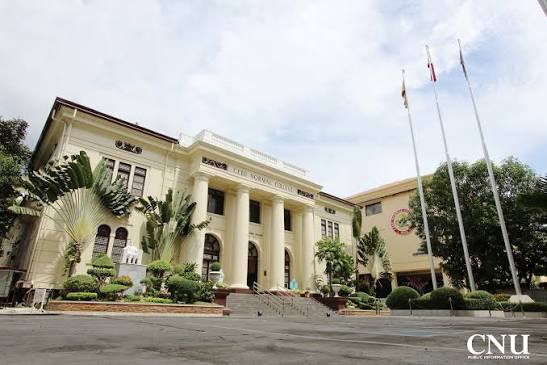
The contractor behind Cebu Normal University’s (CNU) P947.83-million Smart Hub project is ready to resume construction but is awaiting the university’s authorization to proceed with the remaining work.
Lancaster Technology and Development Corporation (LTDC) said in a press release that it remained prepared to complete the project, which was suspended after a magnitude 6.9 earthquake struck off Bogo City, Cebu, on Sept. 30, 2025.
The tremor damaged the Academic Center for Arts and Sciences (ACAS), one of the structures included in the project. The building tilted toward an adjacent structure, prompting safety concerns.
In October 2025, city officials recommended that the affected buildings remain unoccupied until they were declared safe, further delaying the university’s modernization initiative.
To help address the resulting shortage of classrooms, LTDC said it was coordinating with CNU and the Cebu Provincial Government on a proposal to establish an annex building on available idle land.
“Upon reaching an agreement, the space would help address classroom shortage caused by the earthquake while ensuring students are provided with modern, technology-equipped learning spaces under the Smart Hub project scope,” the company said.
LTDC also addressed questions surrounding the project’s learning management system (LMS), one of the components examined in the Commission on Audit (COA) report on the university.
The contractor maintained that the platform was already operational and being used by CNU.
It also said it conducted deployment training for university faculty members in November 2025 to familiarize them with the system.
The clarification comes after state auditors flagged 1,000 Apple iPad 10th-generation tablets worth P28.25 million that had remained in storage at CNU’s Tandang Sora function hall.
The devices were delivered and accepted on May 14, 2025, but had yet to be distributed for use, according to the COA.
Auditors warned that prolonged storage could expose the tablets to damage, loss and technological obsolescence. They also noted that the arrangement deprived students and other stakeholders of the function hall’s intended use.
LTDC said the iPads and MacBook laptops had already been delivered and accepted by the university, although payment remained pending. The tablets were awaiting distribution while the project remained suspended.
The Smart Hub project was designed to equip CNU with smart classrooms, electronic laboratories, an e-library, an LMS and other information and communications technology facilities.
However, COA recorded only 34.29 percent project accomplishment as of Feb. 24, 2026.
Auditors also raised concerns about procurement documents, equipment pricing, subcontracting arrangements and payments related to the LMS.
One transaction under scrutiny was a P262.746-million progress payment covering four LMS modules. COA said the functions of the modules had yet to be demonstrated through the required testing.
The auditors noted that the modules were only partially delivered for payment purposes, raising questions about whether the disbursement was sufficiently supported by evidence that the contracted deliverables had been completed and were functional.
LTDC maintained that it was prepared to provide technical assistance and complete the remaining work once CNU formally authorizes the project’s resumption.
📷 CNU















Comments