



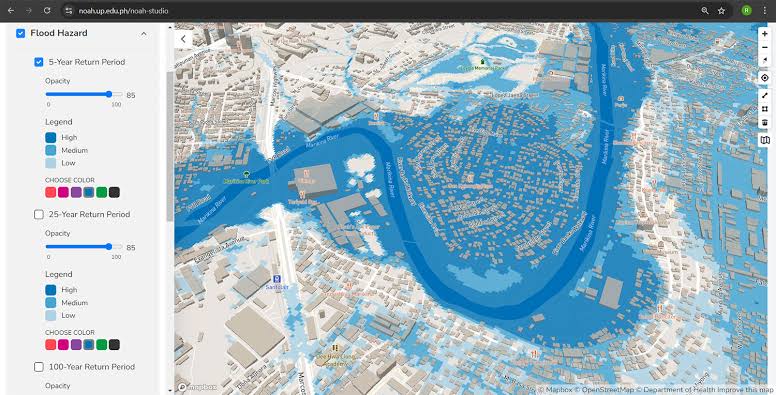
The new P1 billion allocation for Project NOAH (Nationwide Operational Assessment of Hazards) will help identify undocumented waterways and other flood pathways that could guide local governments in preventing and responding to flooding, according to the University of the Philippines Resilience Institute (UPRI).
UPRI Executive Director Mahar Lagmay said the project would locate waterways that have been buried, altered or diverted, particularly in areas prone to localized flooding.
The information could help local governments improve urban planning, drainage systems and emergency response by identifying areas where water naturally flows during heavy rains.
“The floods happen only in specific places. Forty percent to 50 percent of our land area anywhere in the Philippines *ang daming* safe from *baha*,” Lagmay said during a press conference on the P1 billion utilization plan for Project NOAH.
He said flooding does not affect entire cities or regions uniformly, noting that inundation often occurs near creeks, streams and low-lying areas that may remain dry during normal weather.
UPRI YouthMappers had previously identified hundreds of hidden waterways in Quezon City even before the additional funding was made available.
Lagmay said checking and restoring these waterways would help maintain surface runoff and reduce localized flooding during heavy rains.
The P1 billion allocation will also fund high-resolution mapping of major river basins, support for Oplan Kontra Baha and studies on nature-based solutions for disaster prevention.
The program will also cover simulations of major detention basins, LiDAR drone surveys conducted with state colleges and universities, and the use of artificial intelligence for disaster management.
Lagmay said the funding would allow government and researchers to use more scientific data when planning and implementing projects intended to reduce disaster risks.
“With limited resources in the country, we want to maximize the use of science so that we will be more effective in our investments. That is where we will use the PHP1 billion, and we hope that it’s not only for this year,” Lagmay said.
He said continued funding would be important to prevent government spending from relying on estimates instead of evidence and scientific assessments.
The project is expected to provide data that could help government agencies determine where flood mitigation measures are needed and avoid investments that do not match actual water movement and flood risks.















Comments