
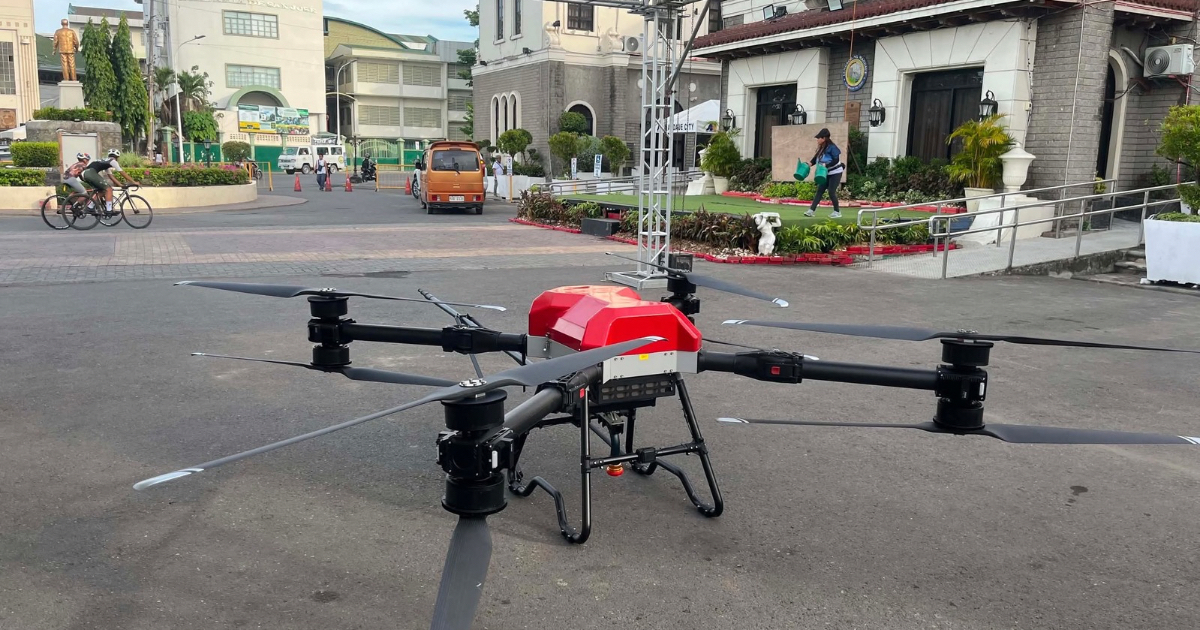
The Mandaue City Government tested Taiwanese-made firefighting drones on May 25, 2026, as part of efforts to strengthen emergency response capabilities for high-rise structures in the city.
The demonstration was led by Mayor Thadeo Jovito “Jonkie” Ouano, together with city officials, the City Disaster Risk Reduction and Management Office (CDRRMO), and the Bureau of Fire Protection (BFP), at the Mandaue City Hall grounds.
Officials said the drones are designed for firefighting operations in tall buildings, which is increasingly relevant as Mandaue continues to urbanize and see a rise in high-rise developments.
“Mandaue being a highly urbanized city, daghan kaayo ta og mga tag-as nga building, maggamit gyud kaayo siya,” Ouano said.
Ouano said each unit can reach up to 100 meters in height and is priced between ₱3 million and ₱5 million. He added that the city is initially considering a rental arrangement before committing to any purchase.
“If ever mukuha man gani ang city, dili lang siguro dayon i-purchase deretso, i-rent lang sa siguro for one year. Just to see kung maggamit ba gyud nato,” he said.
He noted that renting may be more practical in the short term compared to purchasing additional fire trucks, which can cost between ₱20 million and ₱50 million or more.
At present, BFP fire ladders in the city can only reach around 35 meters, limiting response capacity for taller buildings.
However, Ouano raised concerns about safety features of the drones, particularly their ability to operate at high altitude while carrying water hoses.
“Naa man gud tay nakita kining mga gagmay nga drones karon nga kung naay object muhunong siya ba, mao na iyang safety features gani, kani wala pa,” he said, referring to obstacle-detection systems found in smaller drones.
Despite this, the mayor said the city is exploring new technologies to improve disaster preparedness and response.
“It is better to have this than need this, nga when we need it then we don’t have it,” Ouano said.
CDRRMO head Buddy Ybañez also expressed support for the initiative, saying advanced firefighting tools are necessary even if they are not yet frequently used.
“Mas maayo nga naa tay ingon ani bisan wala pa nagkinahanglan kay muabot ra ang panahon nga magkinahanglan ta unya wala tay ingon ani,” he said.
He added that while existing fire safety regulations require buildings of four storeys and above to have their own firefighting systems, additional city-level support remains important.
Fire Officer 3 Alvin A. Torion of the BFP said the technology could help improve both operational efficiency and firefighter safety during high-rise emergencies.
He recalled a past fire incident in Cebu where responders faced difficulty reaching lower floors, underscoring the risks involved in vertical firefighting operations.
“With that, maka ingon ko nga wala nay mga bombero o kinsay responder diri sa Mandaue nga mo undergo ato nga experience. If naa ta ato nga device, mas daghan ta og ma luwas nga kinabuhi,” he said.
Torion said the drones could help extend response capability beyond current limitations.
“Gawas sa madali ang atong operation… mas ma increase ang atong fire responding capability and safe sad ang atong mga responders,” he said.
During the demonstration, officials noted that the drone was capable of maintaining water pressure of around 210 PSI even at elevation. This is higher than typical fire trucks, which usually operate between 80 to 150 PSI.
“The firefighter drone can retain its pressure and that is actually good because it is also capable of fighting up to 100 meters,” Torion said.
“During sa testing ganiha, niabot na siya og 210 PSI… mas kusog kaayo,” he added.
The city said it will continue evaluating the technology, including operational safety and cost considerations, as part of its broader push to modernize disaster response systems amid increasing urban development.
Photo by VCL

Comments