
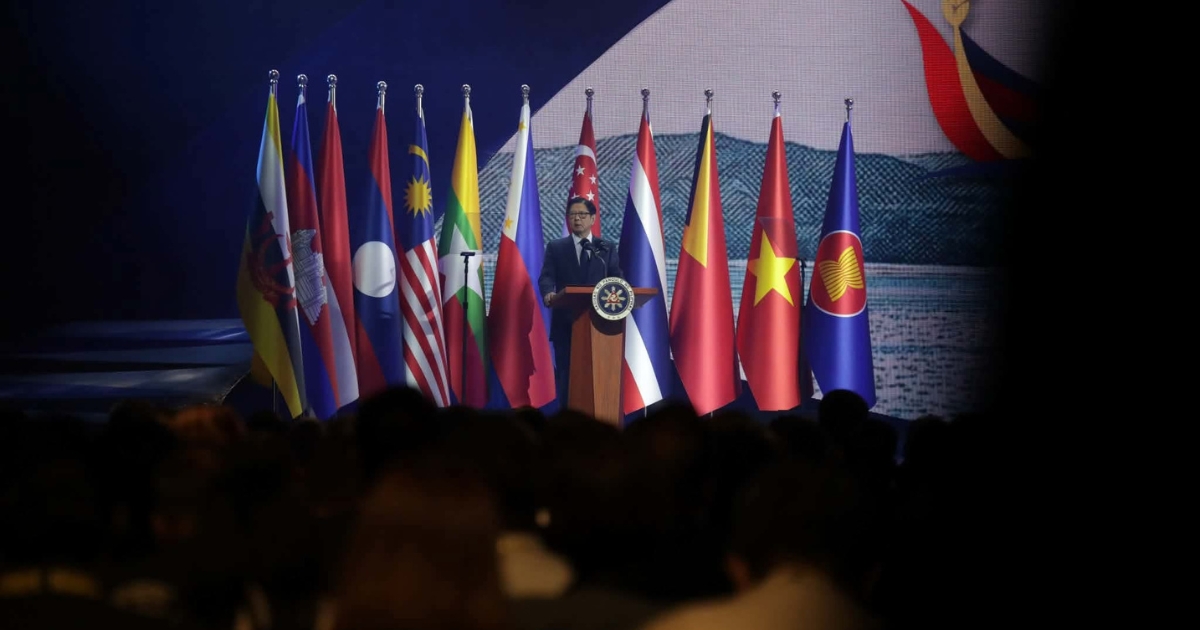
ASEAN Summit opened in Cebu on Friday as President Ferdinand R. Marcos Jr. called on Southeast Asian leaders to strengthen unity and adopt “practical collective measures” to address rising energy pressures and geopolitical instability affecting the region.
During the opening of the 48th Association of Southeast Asian Nations (ASEAN) Summit Plenary, Marcos urged member states to reinforce coordination and preparedness amid volatility in global energy markets driven by conflicts in the Middle East.
“At a time of heightened volatility, ASEAN must strengthen coordination and reinforce preparedness, pursue practical collective measures to safeguard a stable energy supply,” Marcos said.
He cited tensions involving Iran, Israel, and the United States as factors disrupting energy flows and transport routes, leading to supply uncertainties and higher costs across Southeast Asia.
Marcos also emphasized the need for ASEAN to strengthen energy interconnectivity and accelerate renewable and alternative energy development to reduce vulnerability to future shocks while addressing climate change.
He added that innovation and artificial intelligence could improve energy forecasting, grid management, and system flexibility.
“We meet at a time of considerable challenge. Across our region and beyond, nations continue to navigate an increasingly complex global environment,” he said.
“The work of ASEAN must continue, not despite the challenges, but because the times demand our answers to those challenges, for our peoples, for our countries, for ASEAN,” he added.
The President noted that ASEAN members have adjusted their hosting arrangements this year, including scaled-down activities, after the Philippines declared an energy emergency due to global fuel supply concerns.
Despite the adjustments, Marcos said ASEAN continues to push coordination under its political-security, economic, and sectoral pillars, including meetings among foreign, economic, agriculture, and energy ministers.
“We have all done what we can—individually and collectively—to ensure that even amidst uncertainty, the work of building our ASEAN Community continues,” he said.
Marcos also stressed broader regional concerns, including food stability and the protection of ASEAN nationals abroad.
He reaffirmed the Philippines’ chairship theme “Navigating Our Future Together,” which frames this year’s discussions under peace, prosperity, and people empowerment priorities.
“If there is one lesson ASEAN has learned over the decades, it is that difficult times do not divide us,” he said.
“For ASEAN, challenges present us with opportunities that have further strengthened our resolve to work more closely, to listen more carefully, and to act more purposefully.”
ASEAN leaders from Brunei, Cambodia, Indonesia, Laos, Malaysia, Singapore, Thailand, Timor-Leste, Vietnam, and Myanmar attended the summit, where discussions focused on energy stability, food security, and the protection of citizens abroad.
Pooled photo

Comments